Cedar Park's Clay Soil Makes Water Damage Worse, TX: Here's Why
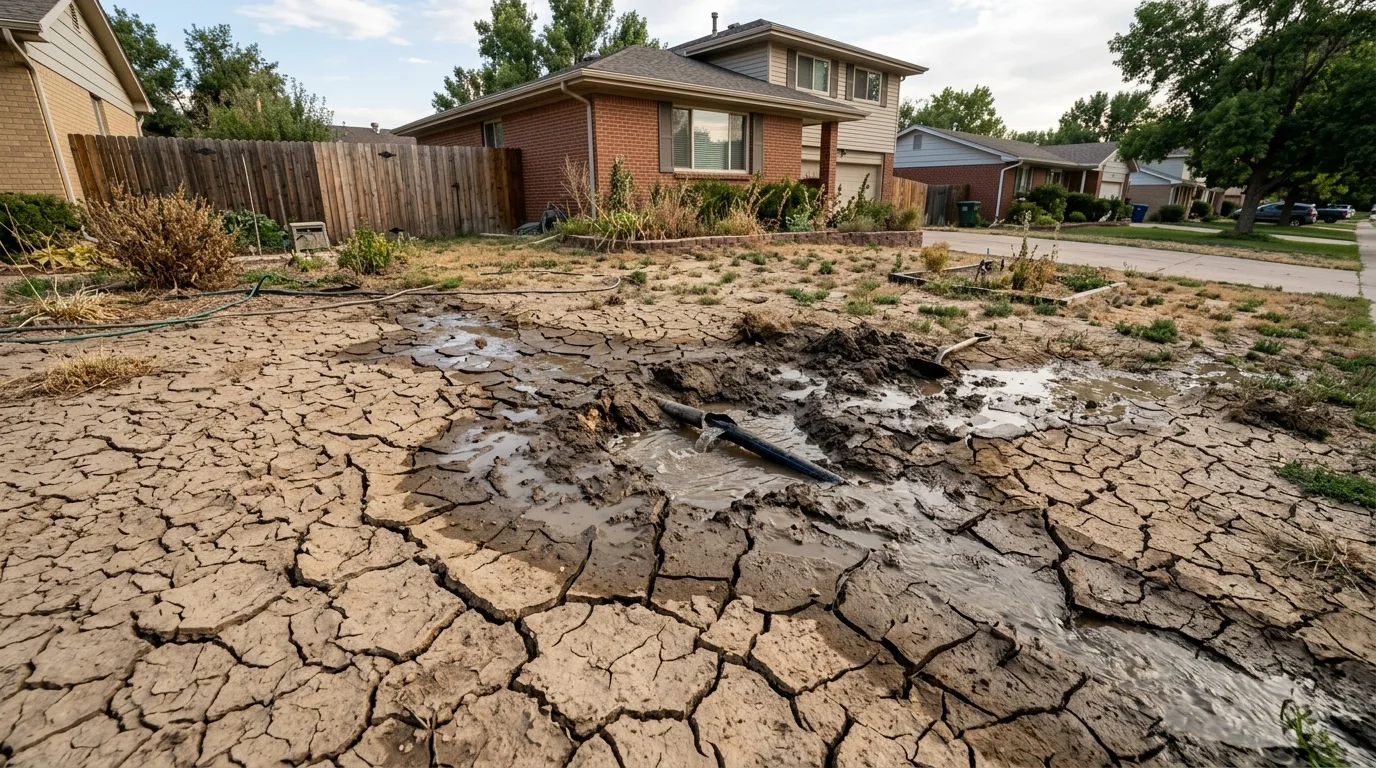
By spring, many Cedar Park homeowners discover water intrusion that opened up when their slab foundation shifted quietly during the dry winter months — hairline cracks that weren’t there last year, flooring that has lifted slightly in one corner, or damp spots appearing under a rug near an exterior wall. This pattern is not random. It’s the predictable result of Taylor Black Clay soil doing what it does every year in Williamson County — and most homeowners don’t realize the connection until the damage has already set in.
In this post, we cover why Cedar Park’s expansive clay soil amplifies water damage, how the shrink-swell cycle creates entry points for water intrusion, and what Cedar Park homeowners on slab foundations need to watch for.
Moisture Coming Through Your Cedar Park Slab?
Thermal imaging and moisture mapping can find sub-slab water that visual inspection misses. Call (877) 698-1311.
Why Cedar Park’s Clay Soil Makes Water Damage Worse
Central Texas’s Taylor Black Clay is one of the most reactive soil types in the country. During drought conditions — which Cedar Park experiences routinely between summer thunderstorms and during winter dry spells — this clay shrinks and loses volume by up to 30%. When it re-saturates during a heavy rain event, it expands back to its original volume, sometimes larger, exerting tremendous upward pressure against anything resting on it.
For Cedar Park’s slab-on-grade foundations, this shrink-swell cycle is the primary driver of foundation movement and water damage. When clay shrinks, it pulls away from the perimeter of the slab, creating a gap at the foundation edge — an entry point for water during the next rain event. When clay expands, it pushes against the slab unevenly, creating differential movement that cracks the concrete. These cracks are often small enough to pass unnoticed during a home inspection but significant enough to allow pressurized moisture to enter the home during storm events.
The Buttercup Creek master-planned community and older sections of Ranch at Brushy Creek sit on particularly deep clay deposits, where this movement can be more pronounced than in newer Cedar Park developments where soil amendment has been used in construction.
Types of Clay-Related Water Intrusion
Perimeter gap flooding: When clay shrinks, water during the next storm event channels directly into the gap at the slab edge — entering the home at the base of exterior walls.
Slab crack seepage: Differential clay expansion creates pressure-induced cracks in the slab itself, through which groundwater can enter during saturated soil conditions.
Pipe penetration failure: Clay movement stresses the pipe sleeves where water lines pass through the slab, eventually breaking the seal and allowing slow water intrusion at those points.
Foundation settlement flooding: Significant clay movement causes sections of the slab to settle — creating low points that collect water from above rather than draining away from the structure.
Practical Signs of Clay-Related Water Damage
- Sticking doors or windows: indicates slab movement from clay expansion — often a leading indicator of future water intrusion at stress points
- Gaps appearing at baseboards: clay shrinkage has pulled the perimeter slab edge away from the wall framing, allowing exterior moisture entry
- Musty odor in one area: sub-slab moisture is wicking through the concrete in a specific zone, often where clay movement is greatest
- Floor tiles cracking or popping up: slab has shifted from clay expansion, breaking the tile bond and creating gaps that allow moisture to enter from below
- Damp spots after rain but not during: clay expansion during saturation pushes existing sub-slab moisture upward through the slab, appearing as wet spots that arrive hours after rain
How Water Restoration Works for Slab Foundations
Standard water damage restoration equipment — air movers and dehumidifiers positioned at floor level — cannot address moisture that sits beneath Cedar Park’s concrete slab. This is the gap that standard restoration contractors without slab-specific experience consistently miss. Homeowners whose properties have been “dried out” using only above-slab equipment often experience mold growth weeks later, originating from the sub-slab moisture that the restoration never addressed.
Sub-Slab Moisture in Your Cedar Park Home?
We use targeted drying protocols specific to slab foundations. Call (877) 698-1311 for an assessment.
Proper slab restoration requires drilling access ports into the slab at strategic points, inserting desiccant dehumidifier tubes beneath the concrete, and monitoring sub-slab moisture with specialized probes until readings confirm dry conditions. This process takes longer and costs more than above-slab drying alone — but it produces a complete result rather than a surface-level one. Foundation repair in Cedar Park can run $3,000–$14,000 when clay movement damage is significant enough to require underpinning, making early detection and proper restoration worth the investment.
Cost Factors Related to Clay Soil
Cedar Park’s clay soil conditions affect restoration cost in predictable ways. Sub-slab extraction and drying equipment adds 2–4 days to any project timeline compared to properties with crawl space or raised foundation access. Multiple port locations increase drilling and restoration labor. And when clay movement has created foundation cracks large enough to require sealing before reconstruction can proceed, that adds a structural repair phase that precedes the restoration rebuild.
Across Williamson County, homeowners in Georgetown — where limestone shelf construction is more common — and in Liberty Hill, where newer construction uses more engineered fill, typically see lower clay-related restoration costs than Cedar Park homeowners dealing with native black clay deposits. This is a local cost reality worth understanding before budgeting a restoration project.
Frequently Asked Questions
How does Cedar Park’s clay soil affect water damage differently than other Texas cities?
Taylor Black Clay in Cedar Park shrinks by up to 30% during drought and expands dramatically when saturated — more movement than soils in most other Texas markets. This creates predictable, recurring foundation stress that produces water intrusion points at slab edges, cracks, and pipe penetrations. The combination of clay movement and Cedar Park’s Flash Flood Alley storm events means properties see both the conditions that create entry points (dry weather) and the conditions that exploit them (heavy rain) in rapid succession.
Can clay-related foundation cracks be repaired without full foundation work?
Minor cracks from clay movement that haven’t yet caused structural misalignment can often be addressed with crack injection and perimeter sealing — which is far less expensive than full foundation underpinning. The key is catching them early, before repeated saturation cycles widen the crack or cause differential settlement. Foundation repair in Cedar Park ranges $3,000–$14,000 depending on severity. Our restoration team identifies clay-related water entry points and coordinates with foundation specialists when structural work precedes our restoration scope.
Do I need a permit to seal or repair foundation cracks in Cedar Park?
Minor sealant application to hairline cracks typically does not require a Cedar Park building permit. Structural foundation work — including pier installation or major slab repair — requires a building permit through the MGO Connect portal, with residential permits issued within 5–7 business days. Contact Cedar Park building services at 512-401-5100 to confirm the permit threshold for your specific scope.
Related:
- Water damage restoration in Cedar Park: 2026 complete guide
- Burst pipes in Cedar Park during winter freezes
- Slab foundation water detection for Cedar Park homeowners
Clay Soil Water Damage in Cedar Park — Call for Expert Help
Cedar Park Water Damage Restoration specializes in slab-foundation moisture issues. Call (877) 698-1311 for a free assessment.