Categories of Water Damage: What Cedar Park TX Owners Should Know
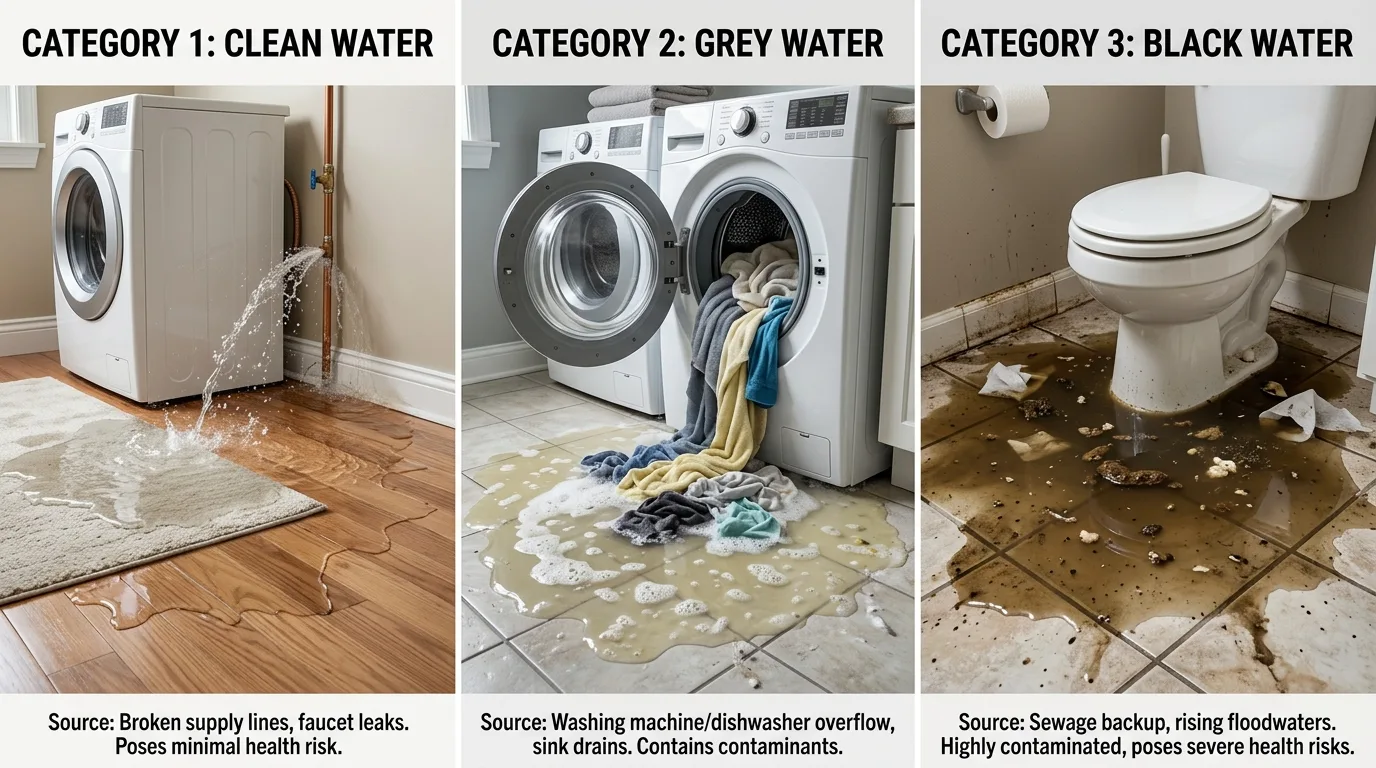
When a restoration contractor tells you your home has “Category 3 water damage,” do you know what that means for your health, your cleanup costs, and your insurance claim? The IICRC’s three-category system for classifying water damage is one of the most important frameworks for Cedar Park homeowners to understand — because water category determines everything: what cleanup protocol is required, what materials must be removed, what the health risks are, and what your restoration will cost.
In this post, we break down each water damage category with examples specific to Cedar Park and Williamson County, explain why category classification matters for Cedar Park’s Flash Flood Alley storm events, and cover what category escalation means when water damage sits unaddressed.
Not Sure What Category Your Cedar Park Water Damage Is?
Free assessment — we classify and scope your damage correctly from the start. Call (877) 698-1311.
Why Water Category Classification Matters in Cedar Park
Cedar Park’s diversity of water damage sources — clean supply line failures, gray water appliance leaks, flash flood storm water, and sewage backup events — produces all three water damage categories with roughly equal frequency across Williamson County homeowners. A homeowner who treats a Category 3 sewage backup like a Category 1 pipe burst — using fans and shop vacuums instead of biohazard protocols — creates a health hazard for their family and a much larger restoration project later.
The category system also matters for insurance claims. Insurers classify claims by water category, and the protocol requirements for each category are codified in the IICRC S500 standard that licensed restoration contractors follow. Documentation that demonstrates correct category classification and corresponding protocol is part of a strong insurance claim package — particularly for Category 3 events where the cleanup protocol adds substantial cost that must be justified to the adjuster.
Category 1: Clean Water
Category 1 water originates from a sanitary source and poses no substantial health risk. In Cedar Park homes, Category 1 water damage sources include:
- Supply line failures: burst pipes, pressurized supply line leaks beneath the slab, water heater supply line failures
- Appliance supply failures: refrigerator ice maker line leaks, dishwasher supply connection failures
- Toilet tank overflow: (not bowl overflow — tank water is potable supply water)
- Rain water through roof: if collected directly without ground contact
Category 1 water damage requires extraction, thorough structural drying, and material assessment for salvageability. Porous materials saturated with Category 1 water can often be dried in place if drying begins within 24–48 hours of the water event. After 48 hours, microbial growth on Category 1-saturated materials can promote the water’s effective classification to Category 2.
Typical Cedar Park cost for Category 1 events: $500–$3,500 depending on duration and area
Category 2: Gray Water
Category 2 water contains significant contamination and may cause discomfort or illness if contacted by occupants. In Cedar Park, Category 2 sources include:
- Appliance discharge water: washing machine drain, dishwasher discharge
- Toilet bowl overflow: (from overflowing, not sewage backup)
- Storm water without sewer contact: storm water that has contacted soil but not sewage overflow
- Category 1 water after 24–48 hours: clean water that has been stagnant long enough for microbial growth
Category 2 cleanup requires extraction, antimicrobial treatment of all contacted surfaces, material assessment, and structural drying. Porous materials contacted by Category 2 water require individual assessment — some can be cleaned in place with appropriate antimicrobial treatment if treatment begins quickly; others must be removed depending on material type and contact duration.
Typical Cedar Park cost for Category 2 events: $2,000–$5,500 depending on area and protocol scope
Category 3: Black Water
Category 3 water is grossly contaminated and contains pathogenic agents — bacteria, viruses, and parasites — at concentrations that cause serious illness. Cedar Park Category 3 sources include:
- Sewage backup: main line blockage or municipal surcharge causes sewage overflow through floor drains and toilets
- Flash flood water mixed with sewer overflow: common in Cedar Park during major storm events when municipal sewer systems surcharge
- Category 2 water after 48 hours of stagnation: gray water that has had sufficient time for pathogen development
- Ground water from rising water table: ground water that has percolated through soil containing sewage or chemical contamination
Category 3 cleanup requires full biohazard protocol: containment barriers, HEPA-filtered negative pressure, biohazard-rated PPE, removal of ALL porous materials regardless of apparent moisture condition, and EPA-registered antimicrobial treatment of salvageable structural surfaces. No porous material contacted by Category 3 water can be dried in place — this is an IICRC standard, not a contractor preference.
Typical Cedar Park cost for Category 3 events: $2,500–$10,000+ depending on volume and area
Category 3 Water Damage in Cedar Park? Call Our Biohazard Team
IICRC-compliant Category 3 cleanup with proper containment and antimicrobial treatment. Call (877) 698-1311.
Practical Implications for Cedar Park’s Flash Flood Alley Events
Cedar Park’s spring storm events produce a specific categorization challenge that many homeowners don’t anticipate: flash flood water that enters through low-lying areas or storm drains may begin as Category 2 (storm water with soil contact) and escalate to Category 3 within hours if the municipal sewer system surcharges and backpressure introduces sewage contamination.
Homeowners who begin DIY cleanup on what appears to be storm water — treating it as Category 2 — and later discover the water included sewage contamination face a significantly more expensive remediation from a hygienically compromised starting point. In Cedar Park’s Lakeline Oaks neighborhood and similar areas with older storm-sewer system proximity, having an IICRC-certified technician classify the water at the start of any significant flood event is the safest approach.
Category Escalation: What Happens When Water Sits
Category escalation occurs when water damage that began as one category worsens over time. Category 1 clean water that sits in a Cedar Park home for 24–48 hours without professional extraction begins supporting microbial growth that effectively classifies it as Category 2. Category 2 water that sits for 48+ hours escalates to Category 3. The cleanup protocol required — and therefore the cost — escalates with each category advancement.
This is why response time matters so disproportionately in water damage restoration. A Category 1 pipe burst in a Ranch at Brushy Creek home that is extracted within 6 hours costs $800–$2,500 to mitigate. The same pipe burst that sits for 36 hours before discovery has escalated to Category 2, requiring antimicrobial treatment, broader material removal assessment, and potentially mold remediation if visible growth has begun — often reaching $4,000–$7,000+ for the same square footage.
Frequently Asked Questions
How do I know what category my Cedar Park water damage is?
Category classification requires knowledge of the water source and its contamination potential. Clean supply line failures are Category 1. Appliance discharge or storm water with soil contact is Category 2. Any sewage contact, long-standing stagnant water, or flood water of unknown composition is Category 3. When in doubt, treat as the more dangerous category until a certified restoration technician can assess. Misclassifying Category 3 as Category 2 and treating it with inappropriate protocols creates health risk and future liability.
Does water category affect my insurance claim in Cedar Park?
Yes — Category 3 water damage claims include documentation of biohazard protocol costs that Category 1 and 2 claims do not. Insurers are familiar with IICRC category classifications and typically accept claims where the protocol used matches the documented category. Claims where Category 3 protocol was used but the damage documentation doesn’t clearly support Category 3 classification can be contested. We provide detailed classification documentation as part of every restoration project.
Can Cedar Park flash flood water be Category 3?
Yes — depending on what the flood water contacted before entering your home. Flash flood water that mixed with sewer overflow from a surcharging municipal system is Category 3 regardless of visual appearance. Storm water that entered your home through a damaged foundation perimeter without sewer contact is typically Category 2. The classification matters for cleanup protocol, material removal decisions, and insurance documentation.
Related:
- Sewage backup cleanup in Cedar Park: health risks & protocol
- 5 signs of water damage in your Cedar Park home
- Emergency water removal in Cedar Park, TX
Cedar Park Water Damage Category Assessment — Free & Fast
Correct classification from the start protects your health and your claim. Call (877) 698-1311.